
Home / Knee Treatments
Advanced Knee Care Treatment for Pain-Free Movement in Chennai
Get an accurate diagnosis for your knee pain — and a plan built around your recovery.
Common knee problems Dr. Kanniraj diagnoses and treats
From sports injuries to degenerative disease, each condition gets a precise diagnosis before any treatment plan is built.
ACL Tears
Ligament injuries common in sports that involve sudden stops, pivots, or jumps — treated with reconstruction and structured rehab.
Meniscus Injuries
Tears in the knee's cartilage cushioning, often from twisting movements, causing pain, swelling, and locking sensations.
Osteoarthritis
Cartilage wear that causes chronic pain and stiffness — managed through medication, injections, or knee replacement.
Patellar Dislocation
Kneecap instability or dislocation, treated with targeted therapy or surgical stabilization depending on severity.
MCL & LCL Sprains
Side-ligament sprains from a direct blow or awkward twist, ranging from mild strain to a complete tear needing repair.
Patellar Tendinitis
"Jumper's knee" or "runner's knee" — overuse inflammation of the tendon below the kneecap from repetitive jumping or running.
Knee Bursitis
Swelling and pain from inflamed fluid-filled sacs that cushion the joint, often triggered by kneeling or repetitive pressure.
Chondromalacia Patella
Softening or damage to the cartilage under the kneecap, causing a dull ache that worsens with stairs or prolonged sitting.
Surgical and non-surgical knee pain treatment in Chennai
Dr. Kanniraj recommends the least invasive option that will restore your mobility — surgery only when it's genuinely the right call.
Arthroscopic Surgery
A minimally invasive procedure using a small camera and instruments to diagnose and treat torn meniscus, cartilage damage, and ligament injuries — with smaller incisions and faster recovery.
Read More
Knee Replacement Surgery
When conservative treatment can't relieve severe arthritis pain, total or partial knee replacement restores joint function and quality of life.
Read More

Sports Injury Treatment
ACL reconstruction, meniscus repair, and patellar instability treatment designed to get athletes back to their sport safely.
Read More

Non-Surgical Treatment
Medication, physical therapy, and injections are the first line of treatment wherever they can effectively manage pain, swelling, and inflammation.
Read More
Surgical vs. non-surgical: how the decision is made
Neither path is automatically “better” — the right choice depends on how much structural damage exists and how it responds to conservative care
| Factor | Non-Surgical Care | Surgical Care |
|---|---|---|
| Typically considered when | Pain is early-to-moderate and joint structure is largely intact | Structural damage is significant or conservative care has plateaued |
| Approach | Physiotherapy, medication, bracing, injections | Arthroscopic repair or partial/total knee replacement |
| Recovery pattern | Gradual improvement over weeks with guided rehab | Structured post-operative recovery and rehabilitation program |
| Goal | Reduce pain and restore function while avoiding or delaying surgery | Correct the underlying structural problem directly |
From first consultation to full recovery
A clear, sequential process so you always know what happens next.

Diagnosis
A thorough clinical examination and imaging to pinpoint exactly what's causing your knee pain.

Treatment Plan
A plan tailored to your condition, lifestyle, and recovery goals — surgical or non-surgical.

Treatment
From injections and physical therapy to arthroscopy or knee replacement, delivered with precision.

Rehabilitation
A personalized rehab plan to rebuild strength, restore function, and prevent re-injury.
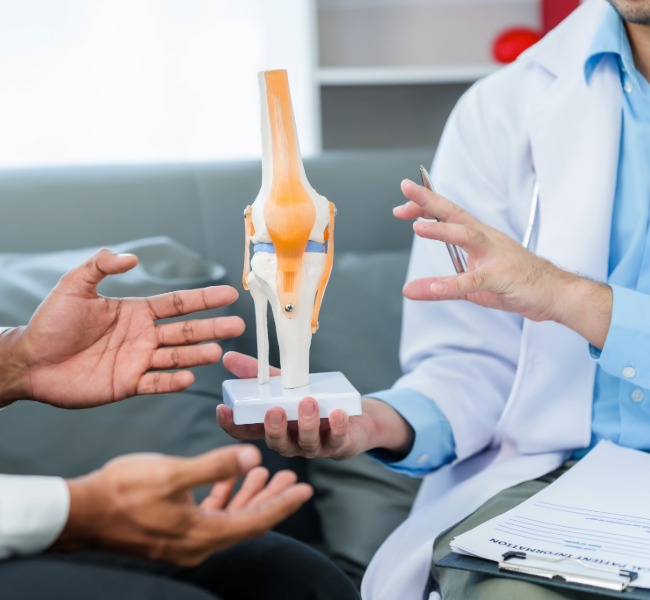
— Dr. Kanniraj, Orthopedic Surgeon
Dr Kanniraj Marimuthu
Orthopedic expertise, delivered around you — not the other way round
- Advanced arthroscopic and minimally invasive techniques that reduce recovery time
- Precise diagnosis across sports injuries, degenerative disease, and traumatic damage
- Personalized post-surgery rehabilitation plans built around your goals
- Non-surgical options considered first, wherever they can genuinely help
Ready to talk about your knee pain?
Book a consultation with Dr. Kanniraj to get an accurate diagnosis and a treatment plan built around your recovery goals.
FAQ
Common questions about knee pain treatment
Straight answers to what patients usually ask before their first visit.
What are the most common causes of knee pain?
Knee pain is commonly caused by ligament injuries such as ACL tears, meniscus tears from twisting movements, osteoarthritis due to cartilage wear, and patellar (kneecap) instability or dislocation. Sports injuries and age-related degeneration are among the leading triggers.
When should I see an orthopedic doctor for knee pain?
You should consult an orthopedic surgeon if knee pain lasts more than a few weeks, is accompanied by swelling or instability, limits your ability to walk or bear weight, or followed a sports injury or fall. Early diagnosis helps prevent further joint damage.
Is knee surgery always required for knee pain?
No. Dr. Kanniraj prioritizes non-surgical treatments first, including medication, physical therapy, and injections, wherever appropriate. Surgery, such as arthroscopy or knee replacement, is recommended only when conservative treatment does not relieve pain or restore function.
What is arthroscopic knee surgery?
Arthroscopic surgery is a minimally invasive procedure that uses a small camera and instruments inserted through tiny incisions to diagnose and treat knee problems such as torn meniscus, cartilage damage, and ligament injuries, resulting in less pain and faster recovery than open surgery.
How long is recovery after knee replacement surgery?
Recovery timelines vary by individual, but most patients begin walking with support within a day or two of surgery, with a structured rehabilitation plan continuing for several weeks to months to rebuild strength and restore full mobility.
Can athletes fully recover from ACL tears?
Yes. With ACL reconstruction and a structured rehabilitation program tailored to the athlete’s sport and goals, most patients regain stability and are able to return to competitive activity.
Where can I get knee pain treatment in Chennai?
Dr. Kanniraj provides comprehensive knee pain treatment in Chennai, covering diagnosis, non-surgical management, arthroscopic surgery, and knee replacement, with personalized rehabilitation plans for each patient.
What does knee pain treatment cost in Chennai?
Cost depends on the diagnosis and treatment path — non-surgical care, arthroscopy, or partial versus total knee replacement all differ in price, as do individual hospital and implant choices. A consultation is the best way to get an accurate estimate for your specific case.
Can physiotherapy alone resolve knee pain?
For many cases of early osteoarthritis, tendinitis, bursitis, and mild ligament strain, physiotherapy combined with activity modification can significantly reduce pain and improve function without surgery. More significant structural damage usually needs additional treatment.
Is knee pain in young adults treated differently than in older adults?
The underlying cause often differs — younger patients more commonly present with sports injuries and overuse conditions, while older patients more often have degenerative changes like osteoarthritis. Treatment goals also differ, with joint preservation prioritized in younger, active patients.
Are PRP or viscosupplementation injections effective for knee pain?
These injections can help reduce inflammation and improve joint comfort for select patients with early-to-moderate arthritis or specific tendon conditions, often used alongside physiotherapy. Suitability is assessed case by case during consultation.
What is the difference between an orthopedician and an orthopedic surgeon?
An orthopedician diagnoses and manages musculoskeletal conditions generally, while an orthopedic surgeon has the additional surgical training to perform procedures such as arthroscopy and joint replacement when non-surgical treatment isn’t sufficient.